Edge Lab
Sweep every version of a strategy against years of real sessions, rank what survives your own filters, and find out whether it held up or just fitted the data.
Market Edge tells you how often something happens. Edge Lab asks a different question: given a strategy, which stop, target, range length and direction actually worked, and would they have kept working on dates the search never saw.
It runs every combination you ask for against real sessions, net of commission and slippage, ranks what clears your filters, and then tries hard to talk you out of the winner.
Pro feature
Free plan users see an upgrade prompt in Edge Lab's place.
Setting up a run
Everything lives in the rail on the left. Four decisions get you a result.
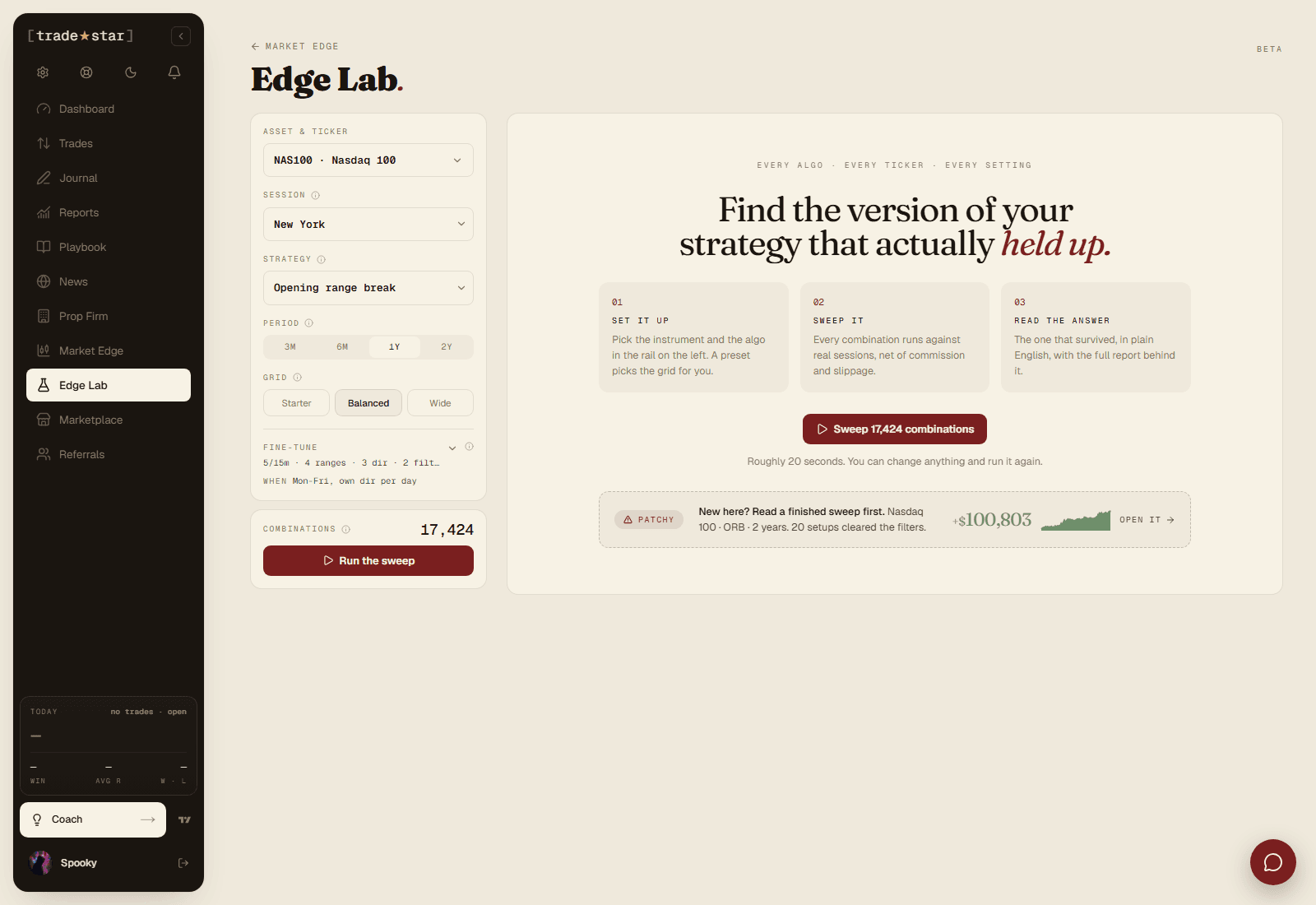
Asset & ticker
The tabbed, searchable picker. Only instruments with real loaded history appear, so an empty tab means no data yet rather than a bug.
Session
New York, London or Asian. The same strategy is a different strategy in each one, so this is a real choice rather than a formality.
Strategy
The family, plus its exit shape. See below.
Period
3 months, 6 months, 1 year or 2 years of sessions.
Grid picks how finely to search: Starter, Balanced or Wide. Balanced is the default and is what most answers should come from. Wide searches the most and takes the longest.
Everything else sits under Fine-tune, collapsed, with its current values printed on the header line so a closed group is never a forgotten one.
The strategies
Four families, each with an optional two-target or breakeven variant.
| Family | What it does |
|---|---|
| Opening range break | Breaks out of the session's opening range. |
| Initial balance | Retracement entry after the first hour's range breaks. |
| Engulfing | Enters as an engulfing candle closes. |
| Gap fill | Fades the opening gap back toward the prior close. |
The exit switches under Fine-tune change the shape rather than the entry. Two targets exits half at TP1 and lets the rest run to TP2. Breakeven after TP1 moves the stop to entry once TP1 is reached, then runs to TP2. A switch that a family does not support is greyed rather than hidden.
What gets swept
Under Fine-tune you control the axes the search walks: chart timeframe, range length or retracement, the stop and target ladders, direction, and the setup pair for gap fill. Below those sit the conditions that decide whether a day trades at all: range size, weekday, entry cutoff and a per-trade loss cap.
The Combinations read-out above the run button is live. It is the number of versions of the strategy about to be tested, and it moves the instant you touch a dial. Watch it: a finer step multiplies the search rather than adding to it.
Per-weekday direction is on by default
The Weekday control opens on own direction, which builds one strategy that trades a different side each weekday and reports it as a single result. It is the strongest thing in here and also the most fitted: those five choices are made using the same data the result is measured on. The answer panel says so, and states how many days were traded out of how many were considered. Set it to as one set if you want a plain single-direction sweep.
Quality filters
Floors and ceilings a combination has to clear to appear at all. Two are on when you arrive.
Minimum trades
On, at 40. Under roughly 40 trades you are reading a sample, not an edge. This is the most important one.
Minimum target hit rate
On, at 25%. The share of trades that actually reached the target. See below for why this exists.
Drop results that look too good
On. Rejects anything above an 85% win rate or a profit factor of 5. This is the one filter it is never sound to relax.
The rest, profit factor, win rate, average return, max drawdown and max losing run, start switched off. A filter that is off is not sent and is not applied.
Why a target hit rate floor. A win here means the trade closed green, which is not the same claim as the setup working. On a far target with a tight stop, most of those wins are positions flattened at the session close rather than targets reached. One measured configuration posted a 42% win rate where the target was reached three times in thirty-three. A win rate floor does not catch that, because those flattens inflate the win rate. This does.
What the run costs you
Every figure is net of commission and slippage, using a cost model per asset class that the report states in full. Nothing here is gross.
Edge Lab flattens every position five minutes before the session close and holds nothing overnight. That is a hard rule of every result it produces, and it matters if you plan to trade one, which is why the export sheet prints the flatten time alongside the session.
If a run is refused
Three refusals, all of them saying what to do:
- Too many combinations. The grid expanded past the cap. Coarsen a step or drop a chart timeframe.
- Still going. The grid was legal but did not finish in the time allowed, so it was stopped rather than left to hang.
- Several sweeps already running. Someone else is using it. Try again in a moment.
Once you have a result, see reading an Edge Lab result.
Market Edge
Pre-computed probability reports from years of historical session data, gap fill, ranges, opens, and more, across Gold and the major US indices.
Reading an Edge Lab result
What the verdict means, why win rate and target hit rate are shown side by side, and how to tell a real edge from the best of ten thousand guesses.