Are You As Profitable As You Think You Are?
 丂卩ㄖㄖҜㄚResearch notes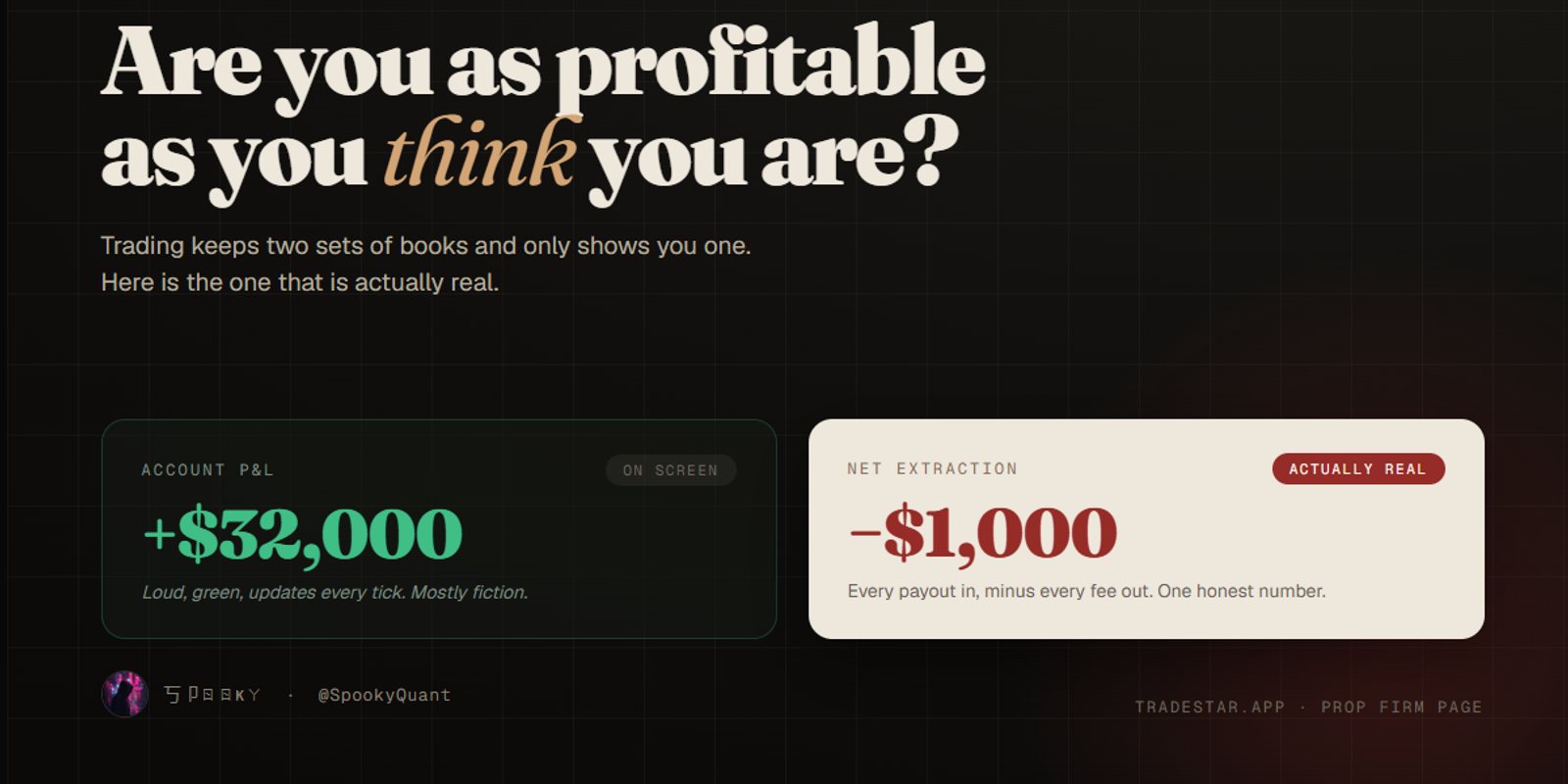
Here's a question that ends most trading conversations. Over the last twelve months, what is your net extraction: every payout that actually landed in your bank, minus every dollar you spent to be a trader in the first place. Evals, resets, data, software, the lot.
One number. Most traders can't answer it within five hundred dollars.
Plenty have never calculated it at all, and a decent chunk of those would find, if they did, that they've been running a profitable-feeling hobby at a loss for years.
The illusion has a mechanism
It works because trading gives you two sets of books and only shows you one.
The account P&L is the one on your screen. It's green, it updates every tick, and it feels like the score. The personal P&L is the boring one: money that left your bank to fund this activity versus money that came back.
The account P&L is loud and mostly fiction. The personal P&L is silent and entirely real.
On a prop account this gets extreme, because the balance on screen was never your money in either direction.
A funded account showing +$32,000 has paid you exactly what you've withdrawn from it, and not a penny more. And here's the bit people really don't sit with: a breached account showing minus $3,700 didn't cost you $3,700 either.
It cost you the eval fee, the activation fee, and whatever reset you bought on the way. Account P&L is fiction in both directions. The only real numbers are cash out of your bank and cash into it.
The occasional payout is what keeps the illusion funded. Pull $2,000 once a quarter and your brain files you under profitable, permanently.
It does not go looking for the $2,800 of fees, subs, and resets that quarter quietly cost, because nobody's brain volunteers for that audit.
The costs nobody adds up
Individually they're all small enough to ignore, which is the design.
Eval fees. Reset fees. Activation fees on passing. The monthly charge on funded accounts some firms run. Market data, which for futures traders is never optional and never cheap. The platform licence. The VPS if you automate. The charting sub you keep alongside the execution platform. Indicators. That course from two years ago you'd rather not count. The journaling app. The second monitor you'd have bought anyway, sure, fine, leave that one out.
None of these feel like trading losses, so none of them make it into anyone's mental P&L. But they're the same money. A trader who nets $4,000 from the markets and spends $5,000 being a trader lost a thousand pounds this year, and will tell you at parties that they're profitable. They're not lying. They genuinely don't know.
Churner or grinder, the maths is mandatory either way
There are two legitimate ways to run prop accounts, and they are different businesses with different accounting.
The churn model buys evals in volume, trades them mechanically, expects to breach plenty, and treats eval fees as cost of goods sold. It lives or dies on unit economics: cost per funded account reached, expected extraction per funded account before it breaches.
If those two numbers are the right way round, breaching accounts constantly is fine. It's inventory turnover, not failure.
The slow model runs one or two accounts carefully, spends almost nothing on fees, and its risk is longevity: one bad interaction with a trailing drawdown wipes months of patience.
Its accounting is simpler but its variance is lumpier.
Both work.
But only if you actually run the numbers for the model you're in. The common disaster is a hybrid nobody chose: churning eval fees at churn-model volume while extracting at slow-model frequency.
That trader has the costs of one business and the revenue of the other, and without a ledger, no idea it's happening.
The fix is a ledger, and it's not complicated
You need four columns: date, item, money out, money in. Every fee on the day it's charged, every payout on the day it lands. One number at the top: the running difference. A spreadsheet does it. Do that much and you're ahead of most of the funded trader population.
I got tired of maintaining the spreadsheet, so I built it into TradeStar instead. The new Prop Firm page tracks every account across every firm, logs every fee and payout, and puts one number at the top of the page: net extraction. What you've actually made, after what it actually cost.
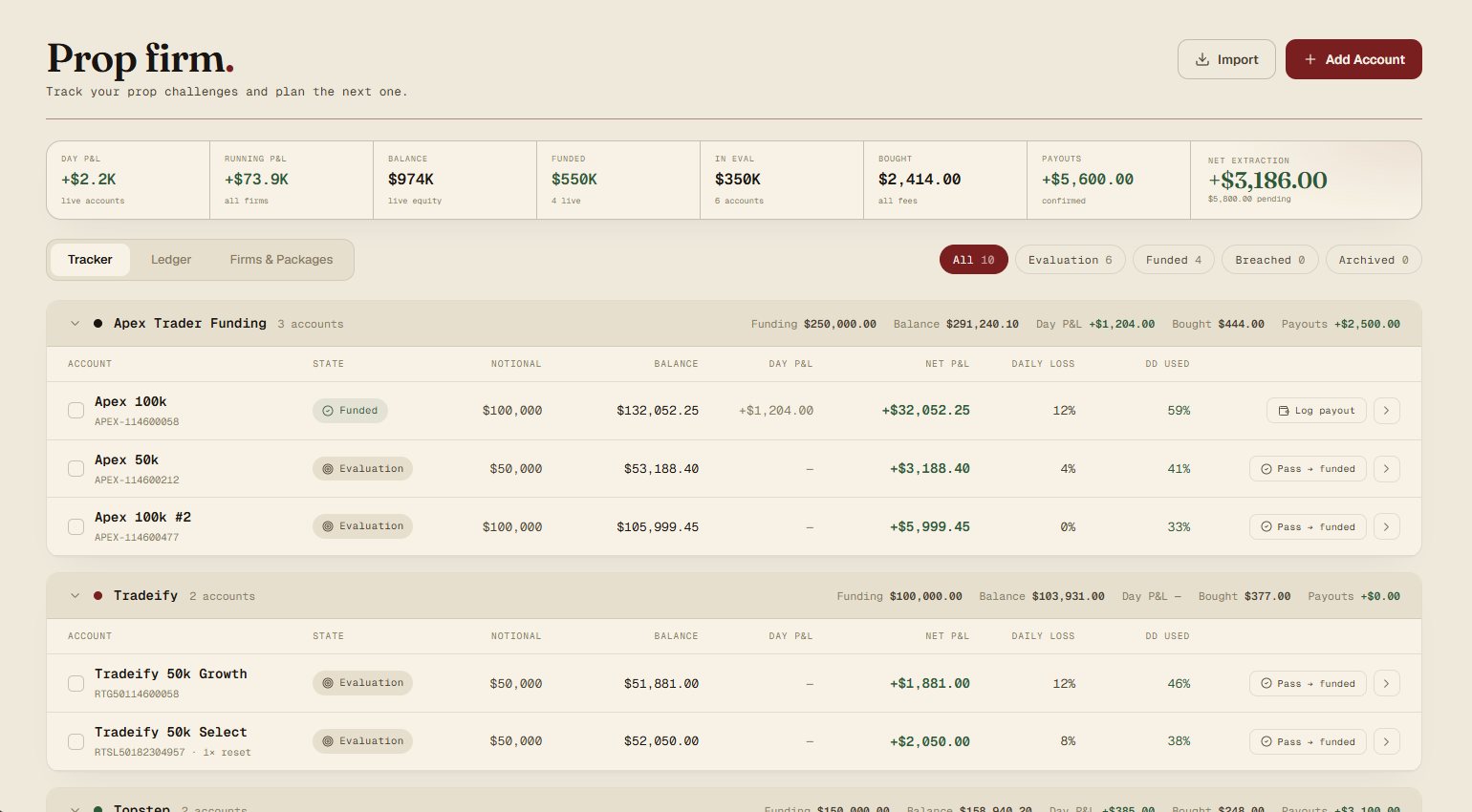
The Prop Firm page in TradeStar: net extraction at the top, everything that fed it below.
It also tracks the stuff that keeps accounts alive, daily loss proximity and drawdown used, but the headline is the honest number, because the honest number is the point.
Use my thing or use a spreadsheet, genuinely no difference to the argument. Just have the number.
The uncomfortable close
If you compute yours and it's negative, that's not shameful, it's tuition, and everyone pays some.
It only becomes a problem when it stays negative for years because you never looked. The industry around trading, the firms, the platforms, the course sellers, all of it, is funded by the gap between how profitable traders feel and how profitable they are. Every sub, every reset, every "one more eval" lives in that gap.
Closing it costs you one spreadsheet and one honest afternoon.
You'll either confirm you're the trader you think you are, or find out you've been the customer all along. Both are worth knowing. Only one of them compounds.
Every base rate in this piece lives in the Hit Rates library, free to read. Or connect your broker and see which of them your own trading actually survives.