So You Want to Be a Trader? The Things I Wish Someone Had Told Me Before I Started.
A few years down the road, here is the honest version — how to tell noise from signal, why an edge has to come before anything else, and what eventually made me hand my execution over to a machine.
Scroll any trading timeline and it looks like everyone is either the most successful trader alive or desperate to become one. This is written for the second group: a heads-up and a learning-curve shortcut from someone a little further down the road. It is my perspective, drawn from my own journey. Others will see it differently, and that is fine.
Ground yourself in reality first
Look at the timeline honestly and you will see the same thing over and over: profit-and-loss screenshots, funded-account certificates, clips of enormous winning trades. Most of it is noise, and there is one simple filter that cuts through it. Are they selling something? A course, Discord access, mentorship, a prop-firm affiliate link.
Ask the obvious question. If someone genuinely prints money trading, why spend all day promoting it and then charge a monthly fee to reveal the strategy? More often than not the answer is simple: there is more reliable money in selling education than in trading itself. In that model the audience is the product, and the subscriber is the exit liquidity.
Underneath that sits an uncomfortable truth. Most people are not profitable. The market arbitrages edges away faster than ever, and a change in market regime can retire a working strategy almost overnight. I have watched it happen to my own systems — approaches that performed for months went flat the moment market character shifted. If nobody warned you about that, consider yourself warned now.
What actually matters
One question should drive everything you study: is this reliable, repeatable, and expressible in mechanical form? Can you write the rules down precisely enough that you would take the exact same trade twice? If you cannot, you do not have a strategy — you have a feeling.
A great deal of what is sold fails this test. It trades in subjective, loosely defined concepts, where two students looking at the same chart can take opposite trades and both insist they followed the system. That is not an accident. Vague rules are unfalsifiable, and an unfalsifiable method can never be proven wrong — convenient for the seller, useless for you.
Judged purely on that "mechanical and repeatable" standard, here is my honest assessment of what I have studied:
Fails the test — ICT, SMC. Not because the underlying ideas are worthless, but because the definitions are loose enough that you can rarely take the same trade twice. If you cannot take it twice, you cannot test it. If you cannot test it, you cannot know whether it works. A method that can never be wrong can never be shown to be right either.
Some merit — The Strat, CRT, support and resistance, trendlines, many indicators. These can at least be written down as rules and tested. Most of them test out weaker than their reputations suggest, but they are honest enough to be measured, which already puts them ahead of the tier below.
Closest to the truth — order flow, volume profile, Auction Market Theory, the DOM. This is where I have ended up, for a simple reason: it is the closest thing to cause. Real orders moving real price, trapped participants forced to cover, genuine levels being defended. It is mechanically observable, testable, and grounded in how the market actually functions rather than in patterns drawn on top of it.
The edge problem, and the journaling trap
Here is one of the biggest problems in trading: most people do not have an edge and do not know it. Rather than find out, they work on their emotions, their journaling, their mindset. That is a trap, and it is worth being precise about why.
You cannot make a losing method profitable through review and reflection alone. Journaling a negative-expectancy strategy with perfect discipline simply means losing money in a very organised fashion. Edge comes first. Everything else is the execution of that edge.
So my first real piece of advice is to get comfortable being uncomfortable, because finding an edge means testing — a great deal of testing — and watching most of your ideas die. Make every idea as objective and mechanical as you can: clear criteria, written down, no discretion. Then demand statistical evidence. A minimum of around 200 trades, ideally spanning different market regimes. An edge can exist in the current regime and nowhere before it — that is still tradeable, but you need to know that is what you have, because it demands far closer monitoring.
And let me show you why the rigour matters, because it nearly cost me real money. I recently had a backtest showing an 87% win rate and a profit factor close to 3. It looked exceptional. It was not the strategy that was fake — it was the measurement. The platform was counting partial fills as separate wins, inflating the win rate, and a position-sizing quirk meant the stops were being measured incorrectly on that instrument's price scale. After fixing the counting, the real win rate was 81%; the real profit factor was 1.87. Still tradeable — but I learned that from a spreadsheet rather than from a blown funded account, purely because I audit my own numbers as though they are lying to me. They often are.
Here is one more lesson from the same school. I once tried loosening a strategy's entry criteria to get more trades. The original took 43 trades at a 1.73 profit factor. Loosened a little: 66 trades, 1.13. Loosened further: 80 trades, 0.90 — now losing. Every trade I added by lowering the bar was worse than the one before, until the whole thing tipped negative. The selectivity was the edge. You cannot loosen your way to more profit, and you only learn that by testing it rather than assuming.
Emotions, discipline, and why I stopped trading by hand
Back to emotions, because they do matter — just not where most people put them. We are conditioned to feel productive, to be hands-on, to do something. Trading is the opposite. Most of it is doing nothing, and the doing-nothing is the hard part.
This is where journaling actually earns its place: not as a substitute for an edge, but as an execution tool once you have one. If you trade manually, your job is to behave like a machine — composed, executing every valid signal regardless of the streak, the drawdown, the last win or the last loss. The edge lives in the numbers over time, and the moment you start cherry-picking signals on feel, you are no longer trading the thing you tested.
I found that exhausting — genuinely draining, day after day. And eventually the obvious thought landed: my strategy was already mechanical and repeatable, so why was a human executing it at all?
So I automated. At the time, like most people, I was on TradingView — a great charting platform, but with no direct bridge to my broker (cTrader). So I built one: my indicator fired webhooks, and my own code caught them and executed the trades. That bridge became the free TradeStar journal. More recently I have moved to Quantower, where I build the strategies directly in the platform with native broker integration. Trades trigger, execute, and manage themselves with no input from me, and I import the results into my journal to review.
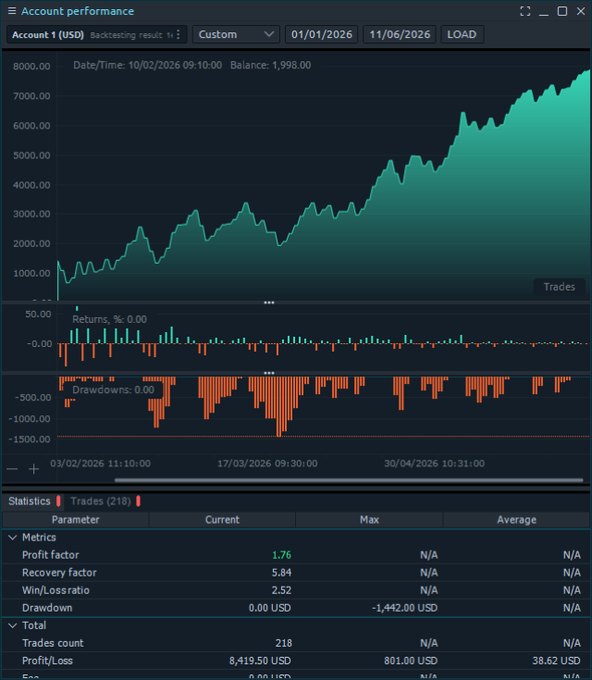
That last part is non-negotiable whichever route you take: review constantly. Your edge is not a permanent possession — it is a lease the market can revoke without notice. You need to know it is still paying at all times, and you need the numbers to know it, not a feeling.
Doing nothing is also a trade
Be prepared to step aside entirely on some days. Today, for me, is one of those. When a major scheduled event lands that I have no data on — the kind of session my strategies were never built or tested against — I stay flat, and I am entirely comfortable being flat. Trading a day you have no statistical basis for is not trading; it is gambling with extra steps.
That, honestly, is the whole game in one decision. Know exactly what your edge is. Prove it with numbers. Execute it mechanically. And when the conditions in front of you are not the conditions you tested, do nothing — and do not feel bad about it for a second.
Nobody sells a course on doing nothing. That alone should tell you something.
Every base rate in this piece lives in the Hit Rates library, free to read. Or connect your broker and see which of them your own trading actually survives.