CRT
Most of what gets called candle range theory online is a chart with three candles drawn on it and a lot of words about liquidity. Underneath the vocabulary is a simple, testable event. A range forms. Price pokes through one side of it and cannot hold there. It closes back inside. That is the whole setup, and it is worth more as a fixed rule than as a story about who got trapped.
A reference candle is the high and low of a fixed window measured from the session open, most often the first hour. A sweep is a bar whose wick reaches past one edge of that candle by at least a minimum depth. The wick, not the close: a close beyond the edge is a breakout, which is a different trade with a different page. The failure is a bar that closes back inside the candle within a set number of bars of the sweep. That close is the entry, at market, trading against the sweep. The stop sits beyond the furthest point the sweep reached, plus a buffer. The target is measured from the edge that was swept, running back across the candle, so one full range is the opposite edge and half a range is the midpoint. The first sweep of the session is the session's only setup. If it fails to reclaim, the session is over, and the other side is not then watched.
How to trade it
Draw it yourself, or let us draw it for you.
Everything you need is in the 6 steps above. No tool, no login, nothing held back.
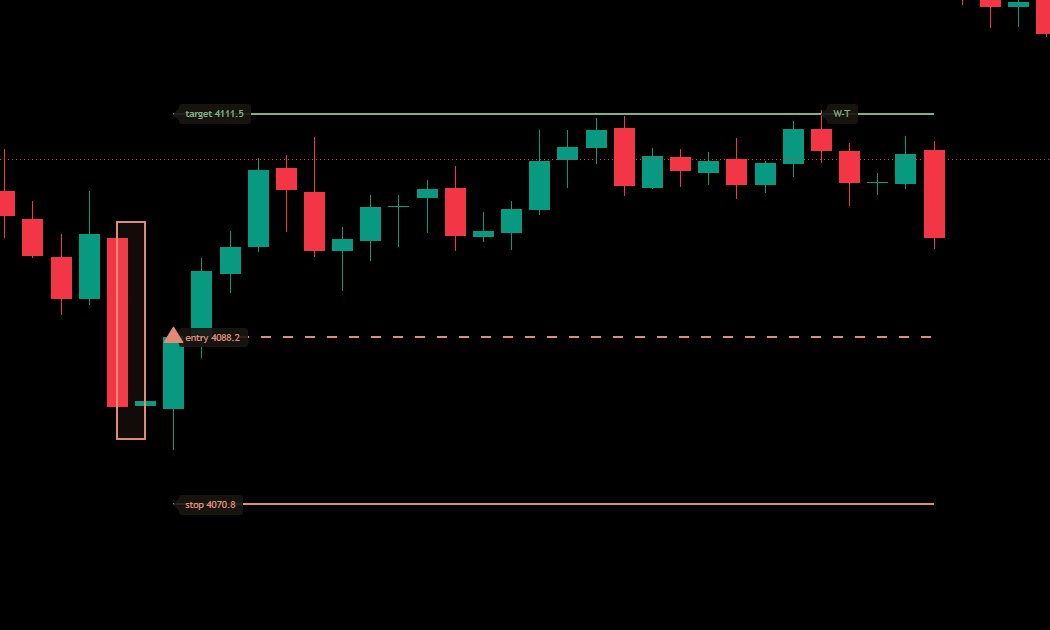
The CRT indicator draws the reference candle, marks the sweep by wick depth rather than by eye, and only fires on a close back inside within the reclaim window. It tracks the extreme across every bar of the sweep so the stop lands beyond where price actually went, and it books every trade at the target, the stop or the session close. It is included with Pro, no extra purchase.
See what you get with ProWhen it fails
A trending session sweeps one edge and keeps going, and the reclaim never comes. That is not a failed trade because there was no trade; it is a session that did not offer the setup, and the rule correctly stands down. The days that hurt are the ones where a bar takes out both edges of the candle in a single move. The order of events inside that bar is unknowable, and a rule that resolved it by picking a side would be inventing a result, so the honest answer is that such a bar produces nothing.
The reclaim can be a pause rather than a reversal: price closes back inside, you enter, and the next bar takes out the sweep extreme and your stop with it. The stop is beyond the wick for exactly this reason, and a buffer past it costs a little on every winner to avoid the stop that gets tagged by a single tick. Because the entry is a market fill at a close, the entry bar itself is already over when the position exists, so its high and low cannot touch your levels. The first bar that can hurt you is the next one.
Related strategies
The setup is yours. Knowing where it holds is the hard part.
Edge Lab sweeps candle range theory across every market and session it has data for, so you can see which instruments actually reclaim the sweep and which simply keep running. It reports how often the trade reached its target separately from how often it finished green, which is the distinction that matters for a setup whose losing case is usually a session that closed out flat rather than one that hit a stop.