NR4 and NR7
Toby Crabel published this in 1990 and it has not needed updating since. A market that just printed its narrowest range in days is a market that has stopped moving, and a market that has stopped moving does not stay stopped. The narrow day is the coil. The next session is the release. Everything else is deciding which way, and how far.
An NR4 day is a session whose range, high to low, is strictly the smallest of the last four sessions including itself. NR7 is the same test over seven. Strictly, because a tie is not a narrow day, and on a quiet instrument with coarse ticks ties are common enough to fake the signal several days running. The optional stricter form, ID/NR4, also requires the narrow day to sit wholly inside the day before it. The trade is the break of that narrow range on the following session. Crabel's own entry is a resting stop order at the narrow day's high or low, not a close beyond it, which is what makes it a different trade from the opening range break and not a relabelled one.
How to trade it
Draw it yourself, or let us draw it for you.
Everything you need is in the 6 steps above. No tool, no login, nothing held back.
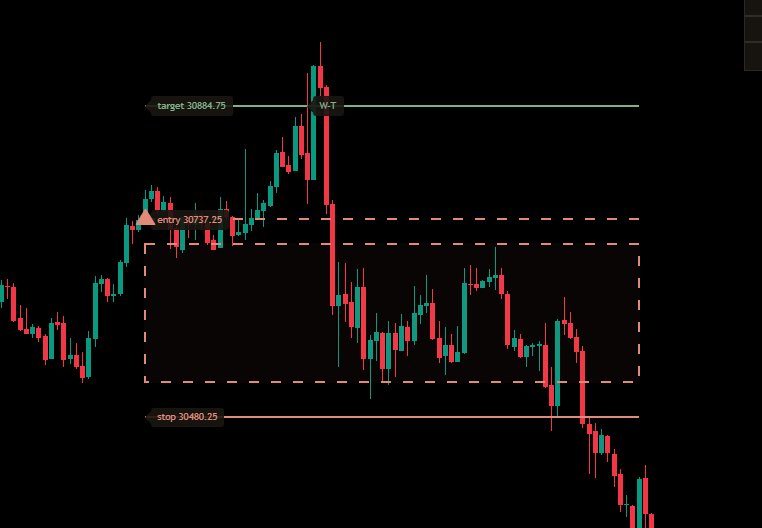
The NR indicator keeps a rolling history of completed session ranges and marks the day that qualifies, so you are never eyeballing whether yesterday was really the smallest of the last seven. It draws the narrow range across the following session, fills at the level or at the open on a gap, and books every trade at the target, the stop or the session close. It is included with Pro, no extra purchase.
See what you get with ProWhen it fails
The narrowest day of the set is often the narrowest because nothing was happening, and the next day can be just as empty. On the Nasdaq the compressed day resolves most of the time, but the direction is not the setup's to give, which is why both stops rest and the first fill decides. Monday coils are the slowest to release, and a narrow day that follows an already enormous session is a market recovering, not winding up, so the widest inside days break out the least. On a 24-hour or overnight session the setup barely exists: there is no bounded open for a range to form against, and the sweep behind this page found no combination that survived on those sessions at all.
The stop order fills on a touch, so a wick through the narrow day's high can put you in on a bar that then closes back inside. That is the price of taking the break as it happens rather than waiting for a close, and it is why the stop sits on the far edge of a range that was, by definition, small. A quick reversal through it is a small loss, not a broken edge. The larger failure is the flat: the break runs, stalls short of the target, and comes off at the close with a few points of gain or loss that the win rate alone cannot see.
Related strategies
You know the setup. Here is when it pays.
Market Edge tells you when a setup is worth trading and when it isn’t. Built on five years of real market history, it measures how any setup actually behaved, by day of the week, by time of day, by the state of the market, and shows the conditions where it paid and the ones where it didn’t. Same setup, very different odds depending on when you take it.
83% is the headline. The trade lives underneath it, in the conditions, so you take the version with the edge and skip the one that looks identical but isn’t.
The setup is yours. Knowing where it holds is the hard part.
Edge Lab runs the NR4 and NR7 definitions across every market and session it has data for, including the stricter ID/NR4 form, so you can settle which definition holds on the instrument you actually trade rather than the one the book was written about. It reports how often the break reached its target, not just how often it closed green.